Kill the Corps V
The Battle of the Potomac

Previous posts in this series have each presented a short case study of the Marine Corps’ role in a conflict immediately following an attempt to disband it to underscore its continued value. The case study for this attempt is clearly the Korean War, especially Operation Chromite. However, due to the size and scope of the Korean War I’ve forgone including it in this post. I don’t have the time or space to do it properly.
This post will cover the Marine Corps in the defense unification debate that led to the National Security Act of 1947 and the creation of the Department of Defense (among other new departments). The best source for the Marine Corps’ role in the defense unification debate is The US Marine Corps and Defense Unification, 1944-47 by Gordon W. Keiser. This post is primarily derived therefrom, but a number of other sources should be highlighted. Revolt of the Admirals: The Fight for Naval Aviation, 1945-1950 by Jeffrey Barlow covers the Navy. The Politics of Military Unification by Demetrios Caraley examines the events covered here from a political science perspective. Organizing for Defense: The American Military Establishment in the 20th Century by Paul Y. Hammond takes a highly critical, historical view of the events. Finally, Amy Zegart’s Flawed by Design: The Evolution of the CIA, JCS, and NSC is the most recent and essential academic look at the issues involved in the debate. All of these works would be necessary for a full description of the unification debate, but this post will only cover the issues directly related to the existence and role of the Marine Corps. Issues such as the creation of the U.S. Air Force and the Central Intelligence Agency are omitted are largely omitted except where they intersect with the question of what to do with the Marine Corps.
In 1931 then Colonel George C. Marshall remarked to a Marine First Lieutenant that Marine recruiting practices that focused on professionalism were unfair and that he hoped to change the situation “someday.” That Marine lieutenant was a young Chesty Puller. By World War II, Marshall is Chief of Staff of the Army and declared to Chief of Naval Operations Admiral Ernest King that he was “going to see that the Marines never win another war.”1 This animus was widespread among Army general officers. In October 1942, a group of Marine officers travelled to Hawaii to train the Army’s 25th Infantry Division in amphibious warfare. By the end of the war, the Marine Corps would train over 40 Army divisions in amphibious warfare, plus a number of other allied divisions. The 25th Infantry’s commander, Major General J. Lawton Collins, spoke to his staff with the Marine team present about how the Army intended to master amphibious warfare and eliminate its dependence on Marines.2 Later at New Caledonia, the team visited with Army Brigadier General Nathan Twining, then chief of staff of the Noumea Army Command, likely because the Marine team included Marine Lieutenant Colonel Merrill Twining, Brigadier General Twining’s younger brother. General Twining launched into a condemnation of the Marine Corps and the Navy which was enthusiastically joined by Collins who described plans to “preclude the Marines from further preempting the functions of the other services.”3 Victor “Brute” Krulak, who relates this story, remarked to the younger Twining that this was surely just brotherly ribbing. Twining, however, said that this was different. It was real.
The First Marshall Plan
And so it was. On 2 November 1942, apparently not busy with anything else at the time, Marshall made his move in a memo proposing a single department after the war.4 The other members of the Joint Chiefs, General Henry “Hap” Arnold and Admiral King, both wanted post-war issues to wait for the war to end.5 The memo generated a report to Congress which in turn produced a House Resolution which was passed in March 1944. Hearings in April 1944 detailed the Army’s plan: a single chief of staff for the armed forces and a single department in the German style, drastically changing the constitutional arrangement of a Department of War and a Department of the Navy with cabinet-level secretaries for each.6
The hearings established the major battle lines of the fight, with Army and Department of War witnesses firmly pressing for military centralization in the name of efficiency and ending duplication, while Department of the Navy witness pointed out that there was no evidence that centralization would increase efficiency. Commandant of the Marine Corps General Alexander Vandegrift focused on the Marine Corps at this time and argued that centralization was hardly necessary for efficiency, pointing out that the Marine Corps at that time the highest percentage of forces in combat operations of any service and had still managed to train Army divisions in amphibious warfare as well as having written the doctrine that the Army used.7
These hearings did not lead to legislation as the War Department hoped but rather to a report on the issues at hand which will be discussed below. The hearings were the initial skirmish of what has come to be known as the Battle of the Potomac. The Marine Corps had previously faced efforts to disband it by the Army, the Navy, and presidents, but never before had it had to do so against a president so firmly aligned with the Army and, at least initially, while simultaneously fighting an actual war. The real battle began when President Harry S. Truman turned his sights on the Marine Corps as well.
Battle Lines and the Birth of the Chowder Society
The goals of the Army and War Department were clear and remained stable throughout the controversies to come. Related by Keiser, they are: “combat effectiveness; military [vice civilian] control; adequate ground troops; establishment of a separate and coordinate air force; economy; and restriction of the Marine Corps.” Restriction here meaning the reduction of the Marine Corps to its ship-board duties. While this allowed the Army to protest that it was not trying to disband the Marine Corps entirely their vision was clearly a death sentence, albeit a slow one. By this time, of course, the role of Marines at sea was essentially only to prepare to fight ashore. The mechanism by which the Army would ensure that the Marine Corps was trimmed out of relevancy was to place the responsibility for entire defense budget in the hands of the Chairman of the Joint Chiefs. Since their plan would also strictly limit the Chairman to non-Marine officers, the outcome would be inevitable.8
The Navy’s goals are equally important although they largely align with the Marine Corps’. The Navy likewise wanted to increase combat effectiveness but also to preserve its organizational integrity. Critically, it wanted to preserve the collective strategy development and civilian control that worked so well during World War II rather than move towards a German model. The Navy felt that the collective strategy development that characterized the Allied victory of World War II was plainly superior to a more centralized system in the style of Germany. It is frankly difficult to disagree with them, but as we shall see the Army tried. The Navy had no problem with the creation of an independent air force so long as it retained the responsibility for naval aviation.
Along with the Army and Navy, the Marine Corps supported the creation of an independent Air Force but also the Navy’s push to retain naval aviation. Of course, its primary goal was its own continued existence. At no point in any of the sources do we see the Marine Corps attempting to expand their power, role, or budget. Instead, it wages a strictly defensive battle to maintain its position as of 1945. It did not even attempt to make a case that the Commandant should join the Joint Chiefs. Its decision to exploit the defense is perhaps the key to its success in this case. The institution’s protective stance was in stark contrast to the Army’s expansive goals to increase its own power and budget at the expense of not just the other services but civilian policymakers and Congress itself. Its other key advantage was simply that it had been here before: neither the Navy nor the Army had ever had to fight for their very existence before. But this was a fight the Marine Corps had already been in and had won many times before.
The thrust of the Army’s argument, at least in public, is that centralization of the U.S. military would increase both efficiency and readiness. The Navy disagreed, pointing to both U.S. success in World War II and German defeat as evidence that these claims could not be supported. This is the major hinge of the debates to follow although this post is more focused on the Marine Corps role.
The Eberstadt Report
Despite failing to push through a quick law to achieve centralization, Marshall and President Truman at this time are in full accord on achieving unification. Secretary of the Navy James Forrestal however, had concerns. He commissioned a report by Ferdinand Eberstadt, a lawyer and banker with extensive commercial experience who had chaired the Army-Navy Munitions Board and had formerly been the Vice Chairman of the War Production Board to examine the Department of War’s claims that unification would foster efficiency and fix problems that arose during the war.9
The Eberstadt Report, transmitted to Congress on 25 September 1945, found the opposite. Eberstadt only agreed with the need for an independent air force but, while warning about the dangers of a unified department in a democracy, instead recommended an additional cabinet-level department to oversee it.
The Collins Plan
While the Eberstadt Report’s findings took some of the wind out of the Army’s sails, so to speak, they would try again. This time J. Lawton Collins, now a Lieutenant General, would be tasked with developing another plan.10
In the Collins Plan, the individual services would be retained but the Departments of War and Navy would be amalgamated into a single department under a “Secretary of the Armed Forces.” The Joint Chiefs of Staff in the Collins Plan would only be an advisory body rather than a German-style general staff with command authority.11 It left the problem of an independent air force to Congress and would retain naval aviation under the Navy.
In Congressional testimony, Army General J.L. Devers blamed a lack of coordination for the Army’s unpreparedness for amphibious warfare prior to the war, despite a number of Army experiments and contributions to doctrinal development, not to mention its long history of amphibious operations. General Dwight Eisenhower also cited centralization as the means to solve the problem of developing landing craft before the war, saying that “it was hard to get anyone interested in the problem.”12 In reality, the Marine Corps and the Army were both interested in landing craft before the war, it was just difficult to get anyone to pay for them.
The strongest testimony against the Collins Plan came from Admiral William Halsey, who focused on the Army’s attempt to push it quickly through Congress without debate as “un-American” and Marine Lieutenant General Roy S. Geiger. Geiger, a pilot by trade, had commanded both Marine and Army units in the Pacific. Geiger was perhaps the most experienced general officer of the war when it came to amphibious warfare. Geiger testified that it was not a lack of coordination that led to the Army’s lack of preparation for amphibious warfare but the Army itself, citing Army and Army Air Service documents that recommended against not only amphibious warfare doctrinal development but also the development of aircraft carriers, dive bombers, and close air support, along with letters from Army generals praising Marine air support during the war. These included General Douglas MacArthur, Lieutenant General Walter Krueger, and General Robert Eichelberger, all of whom were supported by Marine units during the Philippines Campaign.13
George Fielding Eliot, an influential military analyst at the time, was also asked to testify and pushed back against centralization of the U.S. military stating that, “In Germany the Army has always dominated military thought. The results speak for themselves.”14
Although the Collins Plan was a watered-down version of a direct German model, it still directly threatened Marine Corps interests because it would have removed the direct access of the Commandant of the Marine Corps to a secretary. As we’ve seen in this series, Marine Corps advocacy to the Secretary of the Navy was a critical part in maintaining its existence whenever it was threatened. But in the winter of 1945-1946 the Marine Corps realized that this time, the Department of the Navy would not go to the mat for it. Secretary of the Navy James Forrestal, under pressure from both services as well as the President, felt that if it came down to it, the Marine Corps should be sacrificed to protect naval aviation.
The Marine Corps intended to make sure that it would not come down to it. Vandegrift personally felt that the War Department’s plan was more an attempt to abrogate the powers of Congress and concentrate them under the president and a single secretary than it was a direct attack on the Marine Corps. It was at this point that Vandegrift formed the “Marine Corps Board” at Quantico to “study amphibious warfare concepts” but also, and just as importantly, act as a planning organization to protect the Marine Corps in the unification debates to come. This group, which came to be known as the Chowder Society, worked under Brigadier General Gerald Thomas, then Director of Plans and Policies at Headquarters Marine Corps. The Chowder Society was not, as some have claimed, an independent, unofficial organization of Marine mavericks but was quite official and even prepared Vandegrift’s speeches and testimony. While working under Brigadier General Thomas, it was mostly led intellectually and day-to-day by now Colonel Merrill Twining and his primary assistant Lieutenant Colonel Victor “Brute” Krulak, then Director of the Research Section at Marine Corps Schools. These two officers were the most influential in the coming battles.
It was also at this point that President Truman, frustrated with the failure to get anything through Congress, stepped in with a heavier hand. His message to Congress on 19 December 1945 essentially lent his weight to the Collins Plan.
JCS Papers Series 1478
While these events were going on, the Joint Chiefs of Staff produced a series of research papers on various topics. Protected by their classification as top secret, a paper penned by General Eisenhower unveiled the Army’s agenda regarding the Marine Corps in full.
o Limit the Marine Corps to small-scale shore combat in operations where “only the Navy had an interest.”
o Transfer amphibious warfare at any type of meaningful scale to the Army (despite the Army simultaneously claiming that amphibious warfare was obsolete).x
o Limit the total size Marine units to a regiment, and the total size of the service to “50,000-60,000” personnel. It would also be banned from expanding at all during wartime.
o General Carl Spaatz, an Army Air Service officer, also penned a paper, in this case stripping the Marine Corps of aviation units (although not the Navy).15
This full-throated attack on another service of the same country may have no other precedence in history. It was nothing less than an attempted institutional murder and was never intended to be revealed. But as we shall see, it is this report that will cause the most trouble for the War Department’s effort as a whole and Eisenhower personally.
The Bended Knee Speech
Simultaneously, Congress develops another version of the bill, S. 2044, which spurs another round of testimony. Although aware of the JCS papers, Navy and Marine witnesses cannot comment on them given their classification. Admiral Chester Nimitz reiterated the Navy Department’s view that the Army’s proposal for concentration of defense power in a single secretary and the concentration of budgetary power in the Chairman of the JCS would be disastrous. He further testified to the differences between the Army and the Marine Corps, stating that since the Marine Corps is organized as an extension of the fleet and the Army for sustained ground operations, they are complementary rather than duplicative capabilities.16
General Vandegrift matched Nimitz’s concern about the concentration of power and pointed out the possibility that the proposed single department would encroach on Congress’ constitutional powers. He also pointed out the U.S. was not unprepared for the amphibious warfare of World War II given that the Marine Corps had accurately forecast the war’s major muscle movements in 1921, a clear reference to Lieutenant Colonel Earl “Pete” Ellis’ report Advanced Base Operations in Micronesia. He strongly implied that only the Army was unprepared and that centralization would more than likely lead to a lack of preparation, not better preparation.17
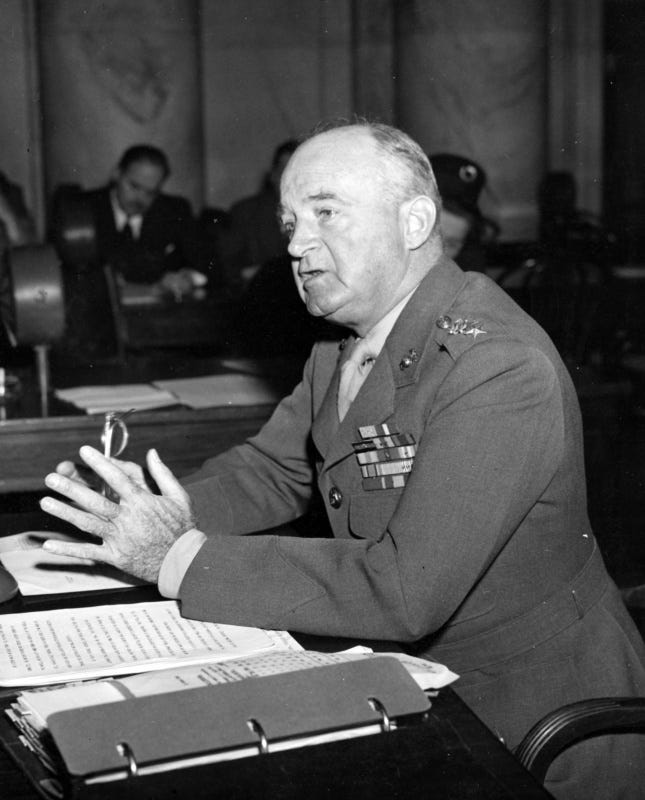
It was during this testimony that General Vandegrift delivered what has come to be known as the Bended Knee Speech. The speech was co-authored by Krulak and Twining and was specifically calibrated to cite Army documents to demonstrate its points rather than Marine Corps documents.18
The Bended Knee Speech is largely credited with saving the Marine Corps, but that was only one of its effects. More importantly it was the dagger in the heart of the Army’s push for an Imperial and Nazi Germany style chief of staff and general staff and its consequent reduction of civilian control of the military. Secondarily, it tipped Congress off to the existence of the unhinged JCS 1478 Series of papers that detailed the Army’s goals behind the veil of a top secret classification. Their subsequent release to Congress at its behest was the twist of the dagger, and even President Truman had to give up his original vision. Nor was the speech the end of the war, it was simply a battle where the Army’s desire for a single, uniformed chief of staff with total power over the U.S. national security establishment was defeated.
The Compromised Second Draft
By June of 1946, less than a month after the Bended Knee Speech, President Truman holds a meeting with both the War Department and Navy Department to work out a deal.
It was at this meeting where the current system of one department under one secretary but with three departments headed by a non-cabinet level secretaries was decided. The wartime Joint Chiefs of Staff system would be retained instead of the German-model of a single chief of staff. In exchange for Navy acquiescence to this arrangement, the War Department and Truman dropped opposition to both naval aviation and the continued existence of the Marine Corps, although Truman especially would continue to oppose legislation that protected the Marine Corps.
The outcome was a twelve-point letter to Congress signed by President Truman that laid out the broad outlines of what would become the National Military Establishment. In response to this meeting, the Senate Military Affairs Committee revised bill S. 2044 along these lines, at which point testimony resumed.
If Truman expected smooth sailing thereafter, he was to be disappointed. Admiral Halsey, as was his wont, continued vociferous resistance. General Vandegrift, however, shifted fires to focus on the need for statutory protection of the Marine Corps. He agreed with the roles and responsibilities of the Marine Corps as per the Truman letter but wanted them enshrined in law not just in executive policy. At this phase, the most enthusiastic defense of the Marine Corps came from Admiral Kelly Turner who baldly stated that the Army was attempting to seize the functions of the Marine Corps.19
However, this cooperation between the Navy and the Marine Corps quickly breaks down. Having secured the existence of naval aviation, the Department of the Navy was less willing to go to bat for the Marine Corps. The two secretaries agreed on outlined legislation and left the Marine Corps out of both the discussions and the resulting proposal.20
The Sheperd Panel and the Edson-Thomas Board
Vandegrift, sensing Navy support slipping away, formed a panel to study the future of amphibious operations in the hopes that it would provide an argument for retention. Initially under Major General Lemuel Shepherd, it was subsequently expanded to include a number of officers, including then Brigadier General Merrit “Red Mike” Edson. Many of the officers already involved in the unification battle were also members of this board, officially called the “Board to Conduct Research and Prepare Material in Connection with Pending Legislation.” This board essentially consolidated efforts with the Chowder Society on ongoing research into amphibious warfare and unification.
Both Truman and the War Department expected quick passage of the unification bill for a few reasons. First, in 1947 both the House and the Senate merged their Military and Naval Affairs committees into the Armed Services Committees that exist today, a result of the Legislative Reorganization Act of 1946. Presumably, legislative unification would presage executive unification. Second, although there was still resistance to unification in both the Navy and Marine Corps, Department of Navy regulations prevented officers of both services from public statements regarding unification and Secretary Forrestal made it clear that even in testimony officers were expected to support the broad outlines of the agreement. No such restrictions existed in the War Department. Despite modern views that Marine Corps public advocacy was a decisive factor in the unification battle, public media was actually dominated by Army views. The Army had both far more trained public affairs officers than the Marine Corps and their activities were not restricted in the same way.21
Vandegrift continued to focus on legislative protection for the Marine Corps and was aided in this by General Eisenhower’s testimony where he essentially acquiesced to the continued existence of the Marine Corps, repudiating his earlier views.22 This muted testimony by the CMC disappointed many in the Marine Corps and among allies in Congress. Congress then also called Brigadier General Edson as a witness. Edson was known to be in opposition to any diminution of civilian control of the military and his testimony regarding the dangers of unification did not disappoint. Even though still in uniform, Edson did not shy away from honestly appraising the proposal, labelling it as a move towards “dictatorship.”23
By summer of 1947, however, it was clear that the bill could not pass in its current form, at least in the newly organized committees. As a result, its supporters shifted the bill to the Expenditures Committee led by its powerful chairman, Clare Hoffman. Hoffman was a known isolationist who focused on domestic policies and therefore would presumably see nothing of interest in the bill and assign it to a subcommittee. This may have been the bill’s supporters’ worst strategic mistake as Hoffman would do nothing of the sort. Unbeknownst to the bill’s supporters in the War Department, Hoffman was personally close with Marines Lieutenant Colonel James D. Hittle and Lieutenant Colonel DeW. Schatzel, both members of the Chowder Society. Hoffman would turn an attempt to slide the legislation through into an all-out brawl.
In April the first witness, Secretary of the Army Robert P. Patterson, walked right into an ambush regarding the role of the Marine Corps and questions driven by the issues discussed in the JCS 1478 papers. Patterson claimed he wasn’t aware of the papers and specifically referred to the committee to General Eisenhower for questions regarding them.24
Hoffman smelled blood immediately and now grilled witness after witness on the papers, demanding their release to his committee. This could not have been chance; Hoffman either already had possession of the papers or was made aware of their contents by Hittle and Schatzel. In testimony, General Vandegrift continued to play it straight and refrained from strong condemnations of the War Department’s proposal, focusing instead on only advocating for the usefulness of the Marine Corps. This again angered Marine supporters but it is clear in hindsight that Vandegrift’s strategy was brilliant. By limiting himself to defending his service he provided Members of Congress with a clear contrast with the War Department’s attempt to gain power and attempts to withhold evidence from them.25
It was Hoffman who finally forced the Army to turn over the JCS 1478 Series to Congress but did not publicly reveal that he had possession of them until General Eisenhower, who apparently did not know that the papers had been released, testified. Hoffman confronted Eisenhower on his hostility towards the Marine Corps, which Eisenhower denied until presented with the JCS paper that he had authored. Eisenhower backtracked by claiming that he was referring solely to Marines that operate landing craft at Normandy but since writing those reports he had been informed that it was actually Navy sailors, not Marines, who operated the landing craft at Normandy. Thus, his previous stance was moot. In his book, Keiser simply says that it is curious that the commander of the Allied forces erroneously thought that he was actually in command of U.S. Marines who transported his troops ashore.26
But we can go a step further. The after-action report for Operation Torch in 1942, authored by Eisenhower, contains a detailed discussion of issues surrounding the differences in training between Navy crews and Army crews and problems experienced by landing craft during the operation.27 It strains credibility that Eisenhower was so detached from the planning for Normandy that issues he himself identified earlier in the war simply escaped his notice later.
It also strained the credibility of his testimony. While he avoided taking personal responsibility for the JCS 1478 papers he authored, the preposterous nature of his statement that he thought it was actually Marines landing the troops at Normandy undermined the credibility of the War Department to the degree that the legislation could not be passed without an amendment specifically protecting the existence of the Marine Corps.
At this point Truman was fed up with Navy and Marine Corps’ ability to influence the bill. He ordered General Vandegrift to dissolve the Edson-Thomas Board and with it the Marine Corps’ ability to mobilize support. Vandegrift did so formally, although efforts clearly continued without direct involvement by Headquarters Marine Corps.28 But the Marine Corps had one more card to play.
Edson Falls on his Sword
Despite success in Congress so far, the now formally-dissolved members of the Edson-Thomas Board still felt a forceful denunciation of the proposed bill was necessary. Edson asks the Commandant for permission to resign to that his testimony could be unfettered by his status on active duty. Although Edson had proposed this once before and Vandegrift had refused, this time he assented.
Edson’s major focus in his testimony is the dangers of the Army’s proposal in civil-military relations. Although he did not use the term, Edson described the proposed bill as creating a military-industrial complex, a “coalition of the armed services” meant to undermine civilian control of American defense. He stated: “This bill will create a coalition of the armed services. I cannot too strongly stress the fact that there can be a monopoly within the military field, just as there can be a monopoly within the industrial or commercial field, and with the same suppressive effects,” accurately predicting the military-industrial complex that came to be. He also criticized the proposed centralization of intelligence under the Central Intelligence Agency as a “potential Gestapo.” While the Bended Knee Speech and the release of the JCS 1478 papers turned the tide against the War Department, Edson’s testimony was the nail in the coffin. It was described by one Congressman as “an atom bomb in the works”29
Outmaneuvered by Edson, Secretary Forrestal rescinded restrictions on Navy and Marine Corps officers disagreeing with the bill, leading to an outpouring of criticism of the bill in public and in testimony, especially by Navy officers. Edson’s defeat of Department level restrictions on testimony had a decisive effect two years later during the Revolt of the Admirals when the Navy pushed back against attempts deprioritize aircraft carriers in 1949.
After Edson’s testimony, War Department attempts to gain more out of the bill than what had been agreed to with Truman largely collapsed. The isolationist Hoffman ironically became a primary architect of the Department of Defense through a revised bill that he asked Lieutenant Colonel Hittle to draft for him.30
The Marine Corps succeeded in having its function enshrined in law and defeating a German-style centralized chief of staff, but it was not recognized as a full service and had no representation on the Joint Chiefs of Staff. Full status as a co-equal service with a seat on the Joint Chiefs would have to wait until the Department of Defense Reorganization Act of 1978. Marine Corps concerns about the need for legislative protection were clearly validated soon after the National Security Act of 1947 was passed. Upon becoming the first Secretary of Defense, Forrestal convened a conference in Key West Florida to work out the roles and responsibilities of the different services. The Marine Corps was excluded from participation and unilaterally limited to only four divisions even in wartime. It was only the legal protection that it now enjoyed that saved it.
Once again it was consistent and effective advocacy by the Marine Corps that preserved its existence, not innovation or professionalism. The analysis performed by the various boards regarding the future of amphibious warfare did bear fruit, but not until well after the Battle of the Potomac concluded. The Edson-Thomas Board included then Colonel R. E. Hogaboom and research continued well after the unification debates, leading to the Hogaboom Report in January 1957. This report and Hogaboom’s work in general captured the implications of emerging technology- especially helicopters- for amphibious warfare and later informed the creation of the modern Marine Air Ground-Task Force structure of the Marine Corps.
Once again, the debate is only finally ended when the Marine Corps plays a vital role in wartime. In October 1949, Army General Omar Bradley testifies to Congress that large-scale amphibious operations will never occur again. Less than a year later, the 1st Marine Division lands at Inchon in Korea, turning the tide against the North Korean offensive. They cleared the way for the Army’s 7th Infantry Division in the exact complementary manner mentioned by Admiral Nimitz in his testimony. The landing, dubbed Operation Chromite, was approved by General Douglas MacArthur, one of the Army generals who had always been effusive in his praise of the Marines. After all, he had spent his time during World War II fighting alongside Marines, not against them.
Conclusion
In his book, Krulak states that, “the Marines congratulated themselves on the National Security Act victory.”31 While it was certainly a victory for the Marine Corps as it preserved its existence, was it a victory for the Republic? Obviously, had the Army succeeded in achieving its goal of centralized, uniformed control of U.S. national security in the German style it would have been worse than the eventual National Security Act of 1947. But almost eighty years on has the Act itself been a success? None of the benefits of greater centralization- efficiency, readiness, and strategic direction- have been realized. The Department of Defense remains one of the least efficient and most expensive organizations in history. The readiness system is broken. American strategy since 1947 has clearly been worse than before by any measure. Meanwhile, all of the predicted dangers- made almost exclusively by the two naval services- have come true. The centralization of intelligence has not yielded the promised immunity from strategic surprise, as those of us who lived through the events of 9/11 can readily attest. American foreign policy is increasingly dominated by a Pentagon with significant presence around the world rather than the Department of State which has repeatedly suffered such drastic cuts to its resources and capacities. Even General James Mattis sounded the alarm on Department of State cutbacks. In the end, the Navy failed to preserve the collective strategy development that won World War II and it was instead centralized under the President and the Secretary of Defense. Looking back at U.S. strategy for the last 79 years, there is just no case to say that the Navy was wrong. In fact, it’s difficult not to conclude that the compromise gave us the worst aspects of both systems: the bloat, inefficiencies, and duplication of a decentralized system with the poor strategic direction and brittleness of a centralized system.
The Battle of the Potomac is notable for the absence of another actor: the Soviet Union. Nowhere is anyone involved in these debates advocating their position as necessary to compete with and defeat the Soviet Union. The debates are not at all threat-informed; they are purely internal. This begs the question: is the National Military Establishment put in place by the National Security Act of 1947 the best fit to compete with and defeat the People’s Republic of China? How could it be?
Eisenhower’s role here is especially important and deserves greater attention. His strident advocacy of defense consolidation should be remembered in the context of his later views as president. President Eisenhower is rightly praised for his warning about the power of the military-industrial complex in his farewell speech of 17 January 1961, but it should also be remembered that that military-industrial complex is a monster that General Eisenhower enthusiastically helped create. Perhaps the wisdom he clearly gained while serving as a civilian despite his previous service as a general is a demonstration that civilian control of the military remains an essential pillar of democracy. This is not to criticize Eisenhower for changing his mind, but rather to highlight that even career military officers as talented as Eisenhower lack the perspective to manage the civil-military relationship of a democracy from inside a uniform. Once he became President himself, he gained the broader perspective that the civilian policymaker must apply to strategy.
While it’s certainly true that the naval services raised the alarm about the Army’s plan because it was in their interest to do so, not just because it was a threat to democracy, they should not have been the only ones to do so. Someone in the Army should have known better and spoken up. The same goes for Truman’s administration and for more members of Congress independent of Navy and Marine Corps advocacy. That they did not should give pause and remind us how close we came to an inherently autocratic system being rammed through federal institutions because a single service wanted to protect its budget and empower itself. Checks and balances exist for this very reason, thus it took other institutions standing up and saying no to stop it. This episode also highlights the benefit of having both a military and a naval perspective in the president’s cabinet, a benefit that was destroyed by the National Security Act of 1947. Diverse advice is better than centralized control of that advice.
Although previous efforts to abolish the Marine Corps were defeated by service advocacy on its own behalf, this example saw a new twist. The Marines working on the issue made a deliberate decision to focus first on the civil-military danger presented by the Army’s attempt to consolidate military power in the hands of a uniformed officer vice a civilian and only secondarily on preserving the Marine Corps’ existence. This is not to say that this was an altruistic service for the Nation; it was clearly in the Corps’ best interest and would indirectly achieve its secondary goal. But this strategy lent the Corps’ advocacy efforts greater credibility and animated members of Congress that otherwise would be disinterested in issues relating to the Marine Corps. They were assisted by strategic missteps by both the Army and President Truman. The Army’s use of highly classified documents to vent its institutional feelings came back to haunt it when those documents were released to Congress. President Truman’s blatant muzzling of the Navy Department views while simultaneously publicizing War Department views also hardened Congressional feelings against any proposal he might back.
The Battle of the Potomac was the last attempt to abolish the Marine Corps. At least so far. But it also came closest to succeeding. Arguably, it did succeed in removing its direct access to a cabinet-level secretary until 1978 when the Commandant was elevated to the Joint Chiefs of Staff.
Keiser, Gordon W. The US Marine Corps and Defense Unification, 1944-1947: The Politics of Survival. Washington, D.C.: National Defense University, 1982. Page 4.
Krulak, Victor. First to Fight: An Inside View of the U.S. Marine Corps. Annapolis: Naval Institute Press, 1984. Pages 17-18.
Krulak, 18.
Keiser, 5.
Rearden, Steven L. Council of War: A History of the Joint Chiefs of Staff, 1942-1991. Washington, D.C.: Joint History Officer, 2012. Page 39.
Keiser, 8.
Keiser, 10.
Keiser, 41.
Keiser, 17.
Keiser, 25.
Keiser, 25.
Keiser, 26.
Keiser, 29.
Keiser, 33.
Keiser, 50.
Keiser, 54.
Keiser, 55.
Krulak, 35-36.
Keiser, 63-64.
Keiser, 69.
Keiser, 85.
Keiser, 91.
Keiser, 93.
Keiser, 99.
Keiser, 100-101 and Krulak, 43-44.
Keiser, 102.
Curatola, John M. Armies Afloat: How the Development of Amphibious Operations in Europe Helped Win World War II. Lawrence: University Press of Kansas, 2025. Page 88.
Keiser, 104.
Krulak, 49-50 and Keiser, 107-109.
Keiser, 105.
Krulak, 52.
Lots of work went into this one—well done.
I was aware of the outlines of this struggle, but not the fines details. Great job on your part and my congratulations to you on bringing this all to light. This is actually tortuous to read in places, but actual history is like that sometimes. The big question now is, where to we go from here? Will Secretary Hegseth’s reform efforts help or not?