Kill the Corps IV
When the Navy is absolutely sick of you

This post is almost wholly taken from Jack Shulimson’s excellent history of the Marine Corps during its first modernization, The Marine Corps’ Search for a Mission, 1880-1898. It’s a must-read book to understand the evolution of the service. You should also check out Gilded Age Marines, the blog by John S. Naylor that covers this time period extensively and will be linked below.
In the last post, the Marine Corps performed mostly small-scale amphibious operations in support of the Navy’s blockade and sea denial campaign during the American Civil War and emerged bloodied but stable. It was that stability that would become a threat over the next few decades. The Marine Corps, having whiffed on an early opportunity to make amphibious warfare their most important mission and the root of their identity, would spend the next fifty some years fighting to maintain Marines’ presence on ships at sea rather than focusing on fighting from the sea. This was done in the persistent belief that if Marines were not stationed aboard warships and only on transports then they would be abolished. This refusal to innovate, rooted in conservativism and institutional paranoia, led directly to calls to abolish the Marine Corps.
The Gilded Age Marine Corps
In the 1870s, the Marine Corps was spread around the world in small ship’s detachments of various sizes. Task organization is already in the service’s DNA; whenever a crisis occurs it consolidates these detachments for service in “battalion” or “regimental” size, although there are no staffs or permanent battalions or regiments of any kind. Headquarters Marine Corps is a small grouping of officers working directly for the Commandant in Washington, DC. Training was almost entirely done on the job. Meanwhile, the Corps is frequently tasked with what is today called support to civil authorities, deploying throughout the country assisting with unrest and guarding infrastructure like railroads and postal routes.
In 1876, Congress cuts the Corps’ size even smaller than its post-Civil War demobilization, down to 2,000 enlisted Marines and 75 officers, and even downgrades the Commandant’s rank from brigadier general to colonel. They also appoint Colonel Charles McCawley to replace Brigadier General Jacob Zeilin who had held the post since the Civil War. McCawley focused on quality of life for the enlisted Marines to stem frequent desertions, increased the discipline and training of individual Marines, and continued Zeilin’s policy that the mission of the Marine Corps was to man Navy ships first and fight ashore second.1
In 1881 and 1882 McCawley successfully advocated for a bill to expand the size of the Marine Corps, but it never came up for a vote. The very next year, a bill instead proposes to abolish the Marine Corps. This bill does come up for debate but is never passed. The most significant legislative event for the Marine Corps in these years is the first authorization of Naval Academy graduates to become Marine officers (Naval Appropriation Act of 1882). This bill also initiated the creation of the “New Navy” and greater professionalization for both services.2
During this time, professional military journals emerged and began driving debates about service policies across the armed forces. In professional journals, Navy officers frequently discuss and debate amphibious warfare and expeditionary operations but few Marines do, reflecting the conservative tenure of McCawley.3 Marine “reformers” are generally more focused on the size and professionalization of the officer corps rather than the mission. Navy officers are anxious to eliminate the Marine Corps role as a police force at sea, instead wanting discipline of sailors to be a Navy function, and one of the earliest recommendations is for the Marines to focus on landing operations, echoing Admiral Dahlgren’s visionary thoughts from the Civil War period. While Marine officers rarely write about the issues facing the service, this period saw the introduction of the Marines’ Manual, perhaps the first manual written specifically for the enlisted corps rather than officers. Penned by Marine 1st Lieutenant Howard K. Gilman, the Marines’ Manual is a precursor of MCDP-1 Warfighting. In 1886, Gilman wrote Naval Brigade and Operations Ashore, which did cover amphibious warfare. Most of the tactical principles Gilman identified would find their way into formal Marine doctrine in later years and some, especially a focus on rapid action, surprise, and deception, presage MCDP-1 Warfighting.
By the 1890’s, the United States realized that its small navy focused on coastal defense must become larger and more capable. One of the reasons for this is a more expansive view of the Monroe Doctrine focused on preventing European economic influence in Central and South America, not just European control of territory. This caused the Navy to form the Squadron of Evolution as an experimental unit, and the squadron’s experiments include amphibious operations exercises in Nice, France.4
But it is still Navy officers pushing the Marine Corps to innovate. Then Captain Alfred Thayer Mahan, working on Navy war plans, writes the Marine Corps into the plan as an amphibious force: “Allusion has been made to mobilize the Marine Corps in certain contingencies. If this Corps be kept up to the standard of its former efficiency, it will constitute a most important re-enforcement, nay, backbone, to any landing force landing on the enemy’s coast. Measures should be framed by which the whole body could be collected.”5 A Navy lieutenant, William F. Fullam, leads the Navy’s charge against the Marine Corps in numerous articles. By this point, it seems like everyone concerned realizes that the Marine Corps is destined to become a full amphibious warfare force, except Headquarters Marine Corps.
In 1891, Commandant McCawley gives up the reins after a decades-long running battle to increase the size and improve the discipline of the Marine Corps, but also to prevent any form of innovation or development of new concepts of operation. Heywood would continue McCawley’s quest to increase the discipline and training of Marines, establishing the School of Application (today called The Basic School) which initially trained both officers and enlisted Marines.
The year 1894 proved to be something of a nadir as the Marine Corps under Heywood faced attacks from Congress, the Navy, the Army, and junior Marines of the reform movement. Senator Eugene Hale led a charge on naval reformation in Congress which includes provisions to abolish the Marine Corps. This time, the Navy lent its support since many of the Navy-focused reforms were vital and long-overdue. Secretary of the Navy Herbert makes no effort to prevent the Marine Corps’ abolishment and Commandant Heywood falls back on McCawley’s old argument that Marines are needed to man naval guns on ships at sea. As the reform bill is debated around Washington, Navy officers circulate petitions to abolish the Marine Corps among the enlisted sailors. Hilary A. Herbert, appalled that Navy officers would take actions that amounted to an enlisted sailor mutiny against the Marines, repudiated the petition. In August of 1894, the Marine Corps comes under attack by the Army when a group of officers convinced a group of senators to propose that would fold the Marine Corps into the Army artillery corps. This bill had little support among the senior Army generals however and it never reached the floor. 6
Marines, however, were beginning to attend the Naval War College and to gain exposure to the ideas that will remake the service. These include influential War College studies of Japanese amphibious Warfare by Captain Richard Wallach. NWC exercises increasingly involve landing operations even though the Marine student population is small.
By 1896, Congress began to significantly expand the Navy and legislation includes increasing the size of the Marine officer corps, although not the enlisted corps, causing significant strain on a Marine Corps now even smaller in ratio to the expanding Navy. In June, Heywood successfully advocated for an increase in 500 enlisted Marines.
Marines in the Spanish-American War
None of these issues, neither the small size of the Marine Corps, its focus on old missions, or its many critics are resolved by the time of the Spanish-American War. But the foundation of a disciplined, expeditionary force established by McCawley and Heywood enabled it to immediately respond and expand. But it did receive emergency appropriations to the tune of $106,529.64, an immense sum for the small service, and one million rounds of rifle ammunition.7
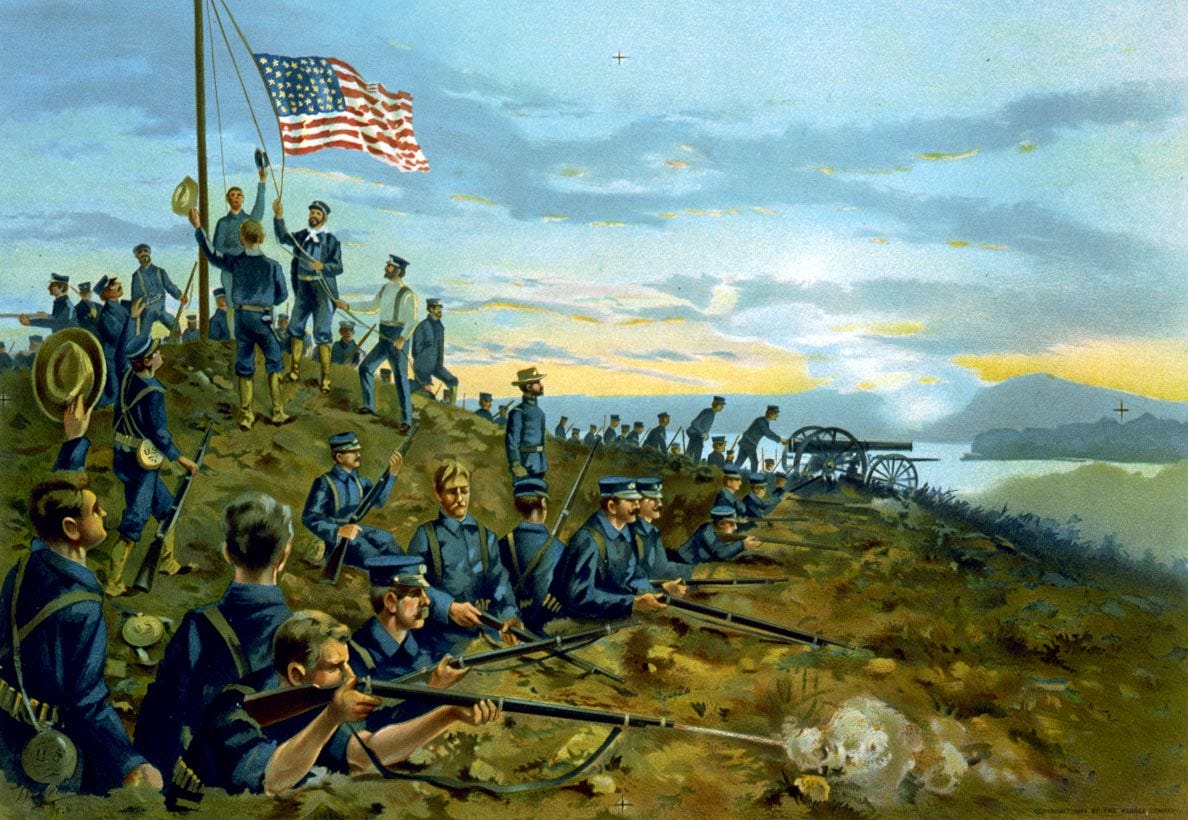
The immediate task is to create and deploy two battalions for service in Cuba, but this was eventually reduced to one. East Coast barracks are drained of Marines to composite a battalion under Lieutenant Colonel Robert Huntington, then commander of the New York barracks. The 1st (and at this time only) Marine Battalion stood at 631 enlisted Marines, 21 officers, and 1 surgeon in five infantry companies and one artillery battery. The battalion left New York on 22 April 1898, just over two months after the explosion of the USS Maine that triggered the war. This is the first time a unit of Marines this size is deployed overseas as is routine today. Previous battalions had either been amalgamated from Marines already abroad or formed for duty in the continental United States.
On 1 May, 1898, Marines participate as in the Battle of Manila Bay when Admiral Dewey smashed the Spanish Fleet. Marines are still manning guns on Navy vessels and so participate in the short battle. After the victory, the USS Baltimore’s Marine detachment under 1stLt Dion Williams goes ashore and occupies the Spanish naval base at Cavite. In the future, Williams would become an important amphibious warfare thinker and Assistant Commandant of the Marine Corps.
By June, the 1st Marine Battalion arrives off Cuba. On 10 June, after meeting up with the U.S. blockading fleet, Huntington’s battalion was sent ashore to seize Guantanamo Bay as a base for U.S. Navy ships. Marine detachments had already conducted a reconnaissance amphibious raid to select the approach. The battalion linked up with Cuban rebels and faced a rolling Spanish offensive that lasts four days in what the battalion called its “one hundred hours of fighting.”8 In the midst of this offensive, two Marine companies and about 50 Cuban rebels launch a counterattack on the Spanish water source six miles away at Cuzco. Cuzco is defended by six Spanish companies, but the Marines coordinate naval gunfire support from the USS Dolphin and succeed in destroying the Spanish base.9 Despite the length of the fight, the Spanish committed their troops in piecemeal fashion and never seriously threatened to overwhelm the Marines. The battle of Guantanamo Bay is the largest ground action by the Marine Corps in Cuba, but other actions include various amphibious raids against targets ashore like signal lighthouses, cable lines, and cable stations in an early example of maritime reconnaissance and counter-reconnaissance.10
The first rapid, overseas deployment of a self-contained, amphibious, combined arms unit presaged the later Marine Corps, especially the Marine Amphibious Units/Marine Expeditionary Units of post-World War II. But the Marine Corps did not yet see the potential. Although Marines are performing amphibious warfare missions in both theaters, at this point they lack specialized equipment to do so. Ship-to-shore movements were conducted from either Navy transports or Navy warships via general purpose small boats. Codified doctrine and specialized amphibious platforms would have to wait for the interwar period even though the British Army and Royal Marines had been developing specialized amphibious platforms and doctrine for centuries.
Post-War
Based on the Marines’ service in the Spanish-American War and new duties to occupy former Spanish territory in Cuba and the Philippines, Colonel Heywood asked Congress for an increase in end strength. Congress agreed and in 1899 passed a law that included an increase to 6,000 Marines, 201 officers, and the rank of brigadier general for the Commandant. The next year, the Marine Corps’ involvement in China began, and nearly 2,000 Marines would be stationed in the Far East after the Boxer Rebellion. These manpower requirements would continue to strain the small service.
By the end of 1900, the Marine Corps’ amphibious warfare was finally mission codified by the Department of the Navy, but it was not General Heywood who made the change. The post-war General Board, in its first year of operation under hero of Manila Bay Admiral Dewey, signed a memorandum directing a permanent, 400-man Marine battalion dedicated to developing amphibious warfare.11 Once again, the Marine Corps passes through an attempt to abolish to end up with an increase in end strength.
This attempt to kill the Marine Corps was finally settled by Executive Order 969, signed by President Roosevelt in 1909. Roosevelt, like Jackson before him, was actually frustrated with perpetual Marine Corps attempts to protect their own interests, especially their presence on Navy ships. Although signed by Roosevelt, the order itself was crafted by Headquarters Marine Corps under now Commandant Major General George Elliot. Elliot finally acquiesced to a new mission for the Marine Corps in the form of advance basing and expeditionary operations and ends the Corps’ attempts to preserve the now obsolete shipboard mission.
Conclusion
The Marine Corps’ traditional technical and tactical proficiency was not enough to protect it from questions about its relevancy and attempts to abolish it. These aspects of professionalism, while obviously important, are not enough to differentiate the service from others. Its unique nature comes from its connection to and relationship with the Navy, not from its professionalism or discipline.
McCawley and Heywood should be applauded for their work in modernizing Marine Corps professionally, but their singular focus on a traditional and preferred mission put the very existence of the service at risk. The core of the Marine Corps’ value is that by integrating with the Navy, the two are greater than the sum of their parts. At the turn of the century, this synergy was only created at the urging of Navy, not Marine Corps, leadership. A poor relationship with the Navy is self-imposed friction that the leaders of the service should always seek to avoid, even at the expense of other priorities. This episode also shows that it is not innovation that preserved the Marine Corps, but service advocacy.
But it was not just the Navy but also junior officers pushing the Marine Corps to change. By the end of this period, company-grade officers flood professional journals and HQMC itself with recommendations for permanent brigade or regiment units and a new focus on amphibious warfare. Young officers point the way through the crisis but are also repeatedly ignored until the commandancy of General John Lejeune and his elevation of the ideas of Pete Ellis, who began writing about a new vision as a junior captain. But the Marine reformers had to push through an overemphasis on one type of ship (in this case the battleship) as the “right” platform for the Marine Corps. Rather than embrace amphibious warfare conducted from transports, the Marine Corps preferred to focus solely on its role on Navy fighting ships which were not designed for amphibious warfare at all.
This is not to say that the Marine Corps is not innovative as a service; it clearly is. Once the Marine Corps finally accepted its new role, its innovation and modernization efforts were extremely effective. This episode shows that professionalism and innovation, while requirements to maintain its existence, are not enough without service advocacy. This lesson would be needed for the fourth and most challenging attempt to disband the Corps when the Army stops playing and really goes for it.
Shulimson, page 41.
Shulimson, 48-49.
Shulimson, 56-57.
Shulimson, 86.
Shulimson, 90.
Shulimson, 130-133.
Shulimson, 170.
Millet, Semper Fidelis, page 132.
The only way to coordinate naval gunfire support in 1898 was to use signal flags. In this instance, Sergeant John Quick was awarded the Medal of Honor for doing so from atop a hill on shore to signal the Dolphin even while under Spanish artillery fire directed at him personally. They missed.
Millet, 130.
Shulimson, 201.
When has innovation been endogenous to the Marine Corps? The Marine Corps has rarely, if ever, truly innovated. The Marine Corps has adapted to avoid dissolution driven by exogenous factors—civilian leaders and adjacent services—rarely, if ever, originating from an internal stimulus. History and its authors have been overly generous to the Marine Corps when a clear-eyed analysis, devoid of any bias or favoritism, would show the Corps in a much different light.
The obsolete mission (amphibious entry) maintained by the Marine Corps further illustrates a service anchored to a past without any meaningful innovative efforts or perception of current events and reality. A return to a historically obsolete mission, which is currently being recommended by the Marine Corps, further reveals a service that cannot imagine a future where it does anything different.