Kill the Corps III
Brother against brother

The second major attempt to abolish the Marine Corps occurred during the American Civil War. This attempt was driven by recruiting struggles during the American Civil War (enlistees entering the U.S. Army were paid much higher wages and bounties than recruits entering the Marine Corps) and the dire need to direct military age males into the Army. Again, it was service advocacy, along with support from the Navy, that forestalled the attempt.
As mentioned in the second installment, the U.S. Marine Corps is extremely active throughout the world during this period. Marines are stationed on every Navy ship and frequently employed ashore for a variety of tasks. But by now, perhaps thanks to Congress having clarified their role, its service identity is coming into existence. Its participation in overseas (the Barbary Wars) and closer-to-home conflicts (the Mexican War) are in its past, although not yet immortalized in the Marines Hymn. Marines wear a distinctive uniform, including the famous blood stripes, but not yet a distinctive emblem. The Marine Corps has little in the way of recognizably modern structure. For work ashore, various ship’s detachments are amalgamated as needed. At sea, Marines perform policing duties, protect the ship from borders, and man roughly 1/3 of the guns on most Navy ships.
Like the other services, the beginning of the Civil War split the service asunder. Twenty of 63 Marine Corps officers left the service, with 19 of them joining the Confederate Marine Corps. The enlisted corps mostly stayed, and no units switched sides as units. Marines stationed at Navy posts in the south were either “repatriated” by Confederates, managed to destroy equipment and return north (Norfolk), or helped to hold forts for the duration of the war (Fort Pickens). In the war’s first major battle at Manassas, the Marine Corps provided a battalion of 12 officers and 353 recruits awaiting training from Marine Barracks Washington. The scratch battalion suffered 10 Marines killed, making stands and spoiling attacks three times during the Union retreat from the battle.
Marines and the Anaconda Plan
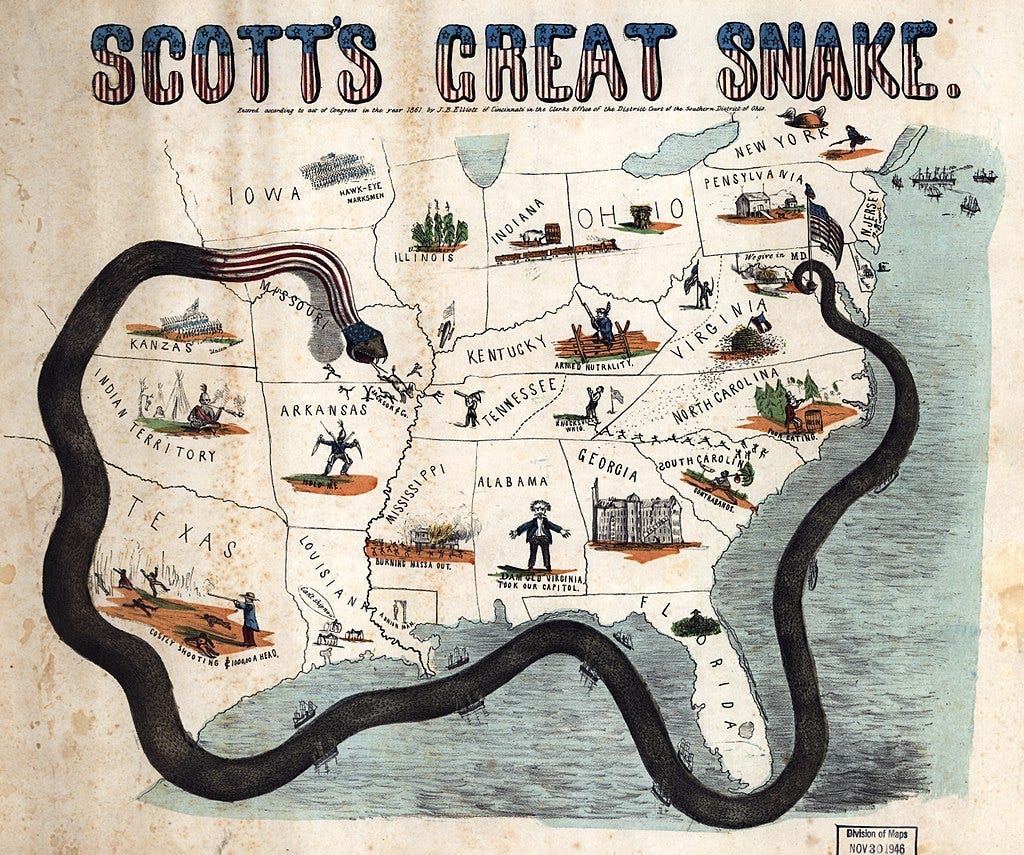
Although its role in the Civil War is not well-known, the Marine Corps is constantly in action and constantly overstretched for the next four years, mostly in support of the Anaconda Plan, General Winfield Scott’s initial proposed strategy to defeat the Confederacy, which the Union did pursue throughout the war. Entire books have been written about the Navy and Marine Corps’ battles to enact the Anaconda Plan, but suffice to say the Marines are in action all around the Confederacy’s periphery. It starts as crisis response: Marines are sent to Fort Sumter as soon as news breaks that Southern forces fired on it, but their ship does not arrive before it falls. Marines are also immediately sent to garrison Fort McHenry and Fort Washington in Maryland.1
After those immediate actions, more deliberate operations in support of the Anaconda Plan take place.
110 Marines are sent to Fort Pickens in Pensacola, Florida and hold it for the U.S. for the remainder of the war.
A 250-man mixed unit of Marines and Army regulars assault and seize Fort Clark at the Hatteras Inlet of North Carolina on 28 August 1861. The next day, Fort Hatteras on the opposite side of the inlet surrenders.
On 7 November 1861, a Navy task force pummeled two Confederate forts at Port Royal, South Carolina (future home of Marine Corps Recruit Depot Parris Island) inducing their defenders to abandon the forts. Marines go ashore to occupy the forts.
On 24 April 1862, A Navy fleet under Flag Officer David G. Farragut fights through two Confederate ports at the mouth of the Mississippi River to New Orleans. The forts surrender and Marines are the first ashore to hold New Orleans against a local mob until U.S. Army troops arrive to garrison the city.
The Army got in on the action too. Ambrose Burnside, the eventual and unfairly maligned commander of the Army of the Potomac in the winter of 1862, earlier led a successful and well-planned amphibious campaign in Eastern North Carolina.
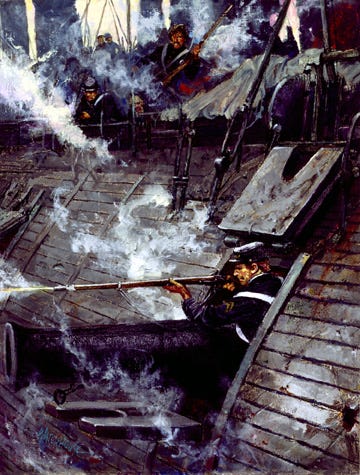
On 11 May 1862, the USS Galena was attacking fortifications manned by Confederate Marines along the James River in Virginia during the Peninsula Campaign. It sustains a hit to its ammunition, and Corporal John Mackie organizes the stunned sailors and Marines to put out the fires and get three guns back into action. It is a rare occasion where U.S. and Confederate Marines fight each other, and Mackie earns the Marine Corps’ first Medal of Honor.
In the spring of 1863, Union forces under Ulysses S. Grant are struggling to reach Confederate held Vicksburg, Mississippi from the north. Farragut sends his senior Marine, Captain Broome. On 23 March, Grant has a private meeting with Captain Broome who convinces him to shift his base to the south of Vicksburg where the Navy can better support a campaign against the city. In an early and excellent example of interservice cooperation, Grant does so, besieges the city, and accepts its surrender on 4 July 1863.
On 8 September 1863, Marines participate in probably the most recognizably modern amphibious assault of the war. Four reinforced-company sized elements of sailors and one of Marines attempted a night landing via small boats on Fort Sumter, South Carolina. At this time, the U.S. lacks purpose-designed amphibious assault craft and codified ship-to-shore doctrine, although the British pioneered these methods over a century before. The attack proves too complex for a force lacking equipment and doctrine for the job. Of about 500 troops, only about 150 made it ashore and most of them were killed or captured.
At the Battle of Mobile Bay, where Admiral David Farragut gave his famous order, “Damn the torpedoes, full speed ahead!”, Marines participate in naval combat at sea against the Confederate Navy and go ashore to secure Confederate forts in the aftermath, earning eight Medals of Honor in the process.2
From December 6-9 1864, U.S. Marines and sailors raid into South Carolina and join with General William T. Sherman’s troops and fight in the Battle of Tulifinney. The same task force fought soon after at the Battle of Boyd’s Neck.
By the end of 1864, the only port left to the Confederacy is Wilmington, North Carolina. Marines participate in the second assault on Fort Fisher, which protected the port, but do not get the chance to assault the fort itself before it is taken. Wilmington becomes an important logistics port for the Union to support Sherman and Grant’s armies.
With the capture of Wilmington, General Scott’s “Great Snake” is complete, isolating the Confederacy from the outside world.3
In short, the Marine Corps is employed in the Civil War as amphibious forces in support of a naval campaign, a core mission of amphibious forces even well before the United States existed. Marines are fighting distributed, small-scale actions in and around littoral areas to seize and hold key maritime terrain, exert sea (and river) denial against Confederate forces, and enable sea (and river) control for the U.S. Navy.
The Congressional Fight
The stress of the Civil War immediately triggered questions for Congress. The first question was expansion. Congress increased Marine Corps end strength to 93 officers and 3,074 enlisted both to provide for wartime expansion and mitigate the losses to defection. President Lincoln used his discretionary powers to increase that number by another 1,000.4
Authorized end strength was one thing, recruitment was another. Congress authorized bounties for enlistment in the Army and states usually added bounties and bonuses for recruits into the units they raised, but the Marine Corps had to constantly advocate to the Department of the Navy and Congress to extend these recruitment measures to the Marine Corps. The Marine Corps was thus perpetually understrength during the war because a recruit could simply make much more money enlisting in the Army.
In 1864, Iowa Senator James W. Grimes, a member of the Committee on Naval Affairs, proposes the following resolution:
“Resolved, That the Committee on Naval Affairs be instructed to inquire into the expediency of abolishing the United States Marine Corps as a naval organization, and of attaching it to the United States Army as the Twentieth Regiment of Infantry, and that they report by bill or otherwise.”
Agreed to by the Senate, the Committee examines the matter.
Before the Marine Corps can react, then Commandant of the Marine Corps Colonel John Harris inconveniently dies. Secretary of the Navy Gideon Wells, who had clashed with Harris on a number of issues, reaches into more junior officer ranks and appoints then Lieutenant Colonel Jacob Zeilin as commandant, forcibly retiring every officer senior to him to avoid complaints about seniority. Zeilin was an aide to Archibald Henderson during the last crisis, and he does the same thing that the Grand Old Man did. Zeilin quickly reacts to the threat, rallies government officials, including Secretary Wells, to advocate to the Naval Affairs Committee to preserve the existence of the Marine Corps. This works, and the resolution dies in committee.
A Future Mission Emerges
Many of the above combat actions were by necessity and tradition performed by shore parties that consist of roughly one-third to one-fifth Marines leading or fighting alongside hastily-formed “battalions” of armed sailors with no training or familiarity in ground combat. This includes even larger scale amphibious assaults like Second Fort Fisher. The infamous retreat of the “Marines” at that battle was actually a group of sailors sent ashore to assault the fort with only pistols and cutlasses, a foolhardy idea from the start. Marines at the battle acted as sharpshooters in support. Marines receive training in fighting as small-units ashore when they are recruited but are not typically organized for shore service. Instead, Marine units are organized for sea duty on their assigned ships. When these ship’s detachments are combined with others ashore, they are typically referred to as battalions but there is no standing organization or even doctrine for such ad hoc units, nor are they necessarily battalion-sized: any amalgamated group of Marines of sailors ashore is just called a “battalion.”
This method was sufficient for both units so far, fighting small-scale skirmishes with indigenous populations or as an add-on unit to the Army, but the Civil War makes it clear that it is ineffective against trained and organized forces. In amphibious warfare doctrine, the Civil War-era U.S. Navy and Marine Corps lag far behind the British (but that’s a subject for my dissertation).
But the first one to realize is not a Marine but a sailor.
Today, Rear Admiral John Dahlgren is remembered for other things, especially being the “Father of American Naval Ordnance” and for the naval base and city in Virginia that now bear his name. Dahlgren would eventually start the process of developing excellent American naval guns. But in 1864 he envisioned a purpose for the Marine Corps beyond even what Commandant Jacob Zeilin, then distracted by the threat from Congress, had then considered.
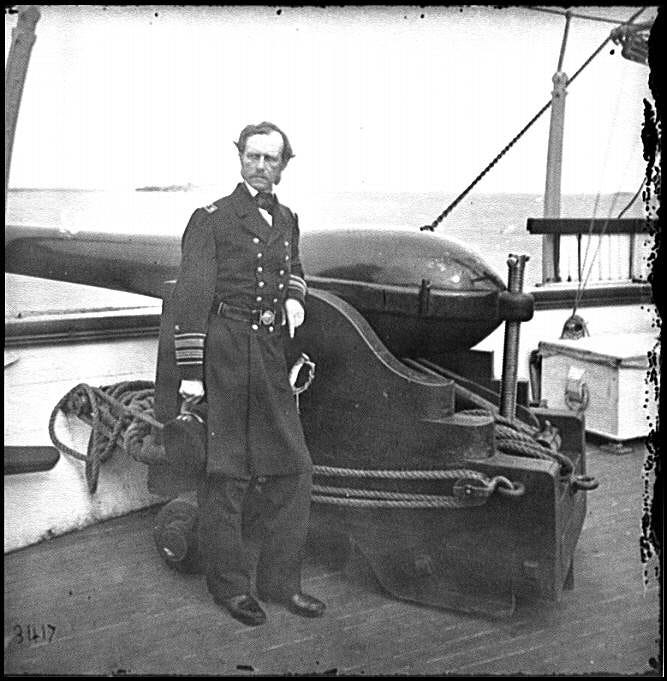
By November of 1864, General William T. Sherman is cutting a swath of destruction through the south, encountering little meaningful resistance. Looking ahead though, there remained some railroads that might enable a Confederate concentration. Dahlgren, then commanding the South Atlantic Blockading Squadron concentrated off Charleston, South Carolina. Dahlgren proposes to go ashore and destroy the railroads ahead of Sherman’s advance to clear his way. He appoints Commander George Preble to lead an amphibious raid to do so. He finds out that there is a parallel Army effort to do the same thing, so Dahlgren instead assigns Preble to support the Army with a battalion of Marines and two of sailors. Due to the aforementioned recruiting crisis, there is only one Marine officer attached to Dahlgren’s squadron: 1stLt George Stoddard. The rest of the Marine contingent is enlisted Marines and NCOs. Dahlgren lands the “Fleet Brigade” and personally drills with them as the Marines train the sailors in the basic of ground combat. Dahlgren’s theory is that an amphibious force that, if it can combine speed, surprise, and maneuver, can achieve outsized effects against a shore-based adversary.
On the night of 29-30 November 1864, the Navy lands 5,000 troops under Brigadier General John P. Hatch at Boyd’s Neck in South Carolina. This joint expeditionary force is composed of the Fleet Brigade and an assortment of Army troops, including the 54th Massachusetts Regiment. Confederate lookouts detect the landing, allowing Confederate forces to block the movement the following day at Honey Hill, where Hatch attacks but cannot break the Confederate line. Hatch withdraws to the Navy vessels at Boyd’s Neck and reembarks the force.
On December 6th, Dahlgren and Patch try again, landing the joint expeditionary force at Gregory’s Landing. Again the joint expeditionary force moves inland to attack the railroad but they again stymied by a Confederate force at the Battle of Tulfinney Creek.
Despite the failure, Dahlgren’s theory is sound. An amphibious force exploiting speed, surprise, and maneuver can defeat land-based adversaries and achieve strategic effects greater than the sum of its parts. The British had mastered the use of just this type of amphibious warfare over a hundred years before the American Civil War, but they had tested and proven doctrine to connect the theory with actual practice. At this time, the United States does not. Had the Marine Corps been as cohesive and well-organized as it would someday become, complete with the structure, theory, and doctrine necessary to perform these kinds of amphibious operations, the result may have been far different. That it did not and would not for quite some time is an unfortunate failure of leaders like Commandants Harris and Zeilin.
Conclusion
The contributions of the Marine Corps are understandably overshadowed by the titanic battles and campaigns of the U.S Army during the Civil War. As a small and at this time perpetually undermanned force, there was no feasible way it could match the Army’s contribution. Poor showings at the first battle of Manassas and the first attempt at Fort Fisher notwithstanding, its record in small-scale, coastal, and riverine warfare and contributions to sea control throughout the war still shows an organization punching above its weight.
The three main service histories consulted here, by Heinl, Millet, and Moskin, all point out that the Marine Corps played a small role in the Civil War. But this discounts the economic aspects of the conflict. While American industry was concentrated in the north at the beginning of the war, the Southern cotton industry could have been used to offset this deficit, and arms could have been purchased abroad. The South’s inability to use the cotton industry to keep their economy going and purchase arms was in part the result of American diplomacy to prevent Great Britain and France from supporting the south. But the Confederacy also lacked the ports and ships necessary to consistently break the Union blockade through smuggling. That fact was made true by the Marine Corps and the Navy which consistently hampered Southern commerce and steadily reduced its access to the necessary forts and ports to support it. The four-volume The United States Marine Corps in the Civil War series by David Sullivan and the one-volume Combined Operations in the Civil War by Rowena Reed are both excellent sources for this aspect, but both are also hard to find in print.
The popular memory of the Civil War also ignores Marine contributions. The Wikipedia article for the Battle of Tulifinney Creek linked above for example, states that its one of the “rare cases” where Marines fought in combat during the war. In reality, Marines are constantly in combat during the war, but at small-scale and partly at sea, participating in ground combat and naval combat simultaneously. This is not to say that they did as much as the Army which grew to gargantuan proportions by the end of the war, but the Anaconda Plan which kept the Southern economy small and isolated simply would not have been possible without the naval services.
In the course of the war Congress faces another decision over whether to abolish or continue the Marine Corps, although this time brought on by the stress of a civil war rather than presidential desires. Again, Congress views the service as necessary and again expands it. It was not innovation that drove that decision and the Marine Corps misses a chance to take advantage of the crisis to increase its relevancy. Both Harris and Zeilin prefer to preserve tradition at the expense of innovation. But it is not the first time the Navy will come looking for the Marine Corps to step up to a new way of doing things.
Heinl, Robert. Soldiers of the Sea: The United States Marine Corps 1775-1962. Page 72.
Sullivan, David M. The United States Marine Corps in the Civil War: The Final Year. Page 69.
This list of major Marine Corps actions in the Civil War was derived from Heinl’s book.
Heinl, 71.