Gallipoli Diaries X
The End of the Line

After the failure of Gallipoli the British shifted focus to the Western Front. But there was no answer there for the type of integrated fortified defenses that the Turks had used to defend the peninsula in 1915. There, the machine-gun infested trenches and pervasive artillery that the British confronted in Türkiye stretched across the entire continent. The British units withdrawn from Gallipoli were all committed to the continent, including the Royal Naval Division who gained a reputation as a highly professional and effective unit.
In 1916, the Royal Navy’s Grand Fleet, which thus far had kept Germany’s High Seas Fleet bottled up in its bases on the North Sea Coast, met a German breakout attempt in one of the largest naval battles in history at Jutland on 31 May to 1 June. Historians continue to debate who won as neither fleet was able to destroy the other Trafalgar style. Some historians point to the fact that the German Navy sank more British vessels and caused significantly more casualties in terms of sailors and Marines to call it a German victory. But this is to misunderstand tactics in general and naval warfare specifically. In On Tactics, I define victory by which side accomplishes their mission. The mission of the Grand Fleet was to maintain British command of the sea by keeping the High Seas Fleet relatively confined to its bases, thus protecting sea lines of communication, especially from North America. The mission of the High Seas Fleet was to break out of the North Sea and contest those sea lines of communication. Despite causing more damage, the High Seas Fleet returned to its bases and never attempted a breakout again. It was the Grand Fleet that accomplished its mission and therefore it is a decisive British victory. The Battle of Jutland is another reminder of the great folly of measuring operations or seeking victory through attrition. If attrition isn’t leading to some other kind of defeat mechanism, it’s irrelavent.
In theory, securing command of the sea in 1916 enabled the British to apply its seapower against the seaward flanks of the German central position in Europe. In practice, however, there were a number of obstacles both metaphorical and literal. Firstly, the Royal Navy still has to contend with the German unrestricted submarine warfare campaign. German U boats are able to leave the North Sea and while many are caught by British mines, traps, and anti-submarine patrols, quiet a few are able to make it through and strike commercial shipping. Secondly, Germany fortified the coastlines they control in Belgium. This does not just include shore-based artillery, coastal mine fields, and German Navy vessels but also the Imperial German Marines.
The first German seabataillon was formed in 1825 by Prussia as the Royal Prussian Marinier-Korps. Like other corps of marines or naval infantry of the time, these troops are manned, trained, and equipped for service with the navy in both offensive and defensive roles, such as defending naval stations abroad. Before World War I, they are organized into three seabataillons. I. Seebataillon is stationed in the Baltic at Kiel, II. Seebataillon is stationed in Wilhemshaven for duty in the North Sea, and III. Seebataillon is stationed at what is now Qingdao in China to defend German territory leased from the Chinese. By 1918, German Marines had seen combat in the unsuccessful defense of Qingdao from a joint British-Japanese amphibious operation in 1918 and had participated alongside the German Army on the Western Front at various places. The German Marines by 1918 were not inexperienced or green troops, but crack fighters that rotated in and out of defensive works on the coast and duty on the Western Front. At the outbreak of the war, the Marinier-Korps had grown to division size. By 1918 it was three full divisions strong.1
In 1918, the British Admiralty and the government in general is largely uninterested in overcoming these challenges. Nor does it have the capacity to do so. The Grand Fleet still has to maintain its distant blockade of Germany in the North Sea and lacks the capacity to lift a large number of troops. Nor are a large number of troops available even could they have been lifted in the same manner as the Royal Navy did at Gallipoli in 1915. But one man wants to try, Admiral Sir Roger Keyes.
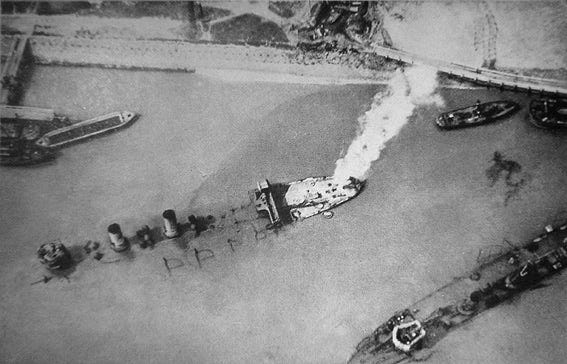
Keyes was present with the fleet at Gallipoli in 1915 and witnessed the whole operation. He was a strong advocate for a more aggressive offensive both when the Navy tried to force the Dardanelles itself and when the Army tried to take the peninsula. By 1918, he had zeroed in on two German navy bases at Zeebrugge and Ostend, canals on the German-controlled coast of Belgium. He resolved to block both bases via a naval raid on Ostend and a combined amphibious and naval raid at Zebrugge. Both canals allowed German submarines and destroyers access to the North Sea. German Navy use of Zebrugge as a forward base depended on the lock depicted at the bottom of the below picture which was defended by a concrete spit that curled around it known as the Mole. The main effort of his plan was to sink three ships in the lock to block it up and to damage it with explosives. To prevent the German artillery from destroying the block ships as they sailed towards the lock, troops would land on the Mole, take the coastal guns, and destroy them before withdrawing. These two tasks had to occur simultaneously to prevent the Germans from responding to either threat in time.
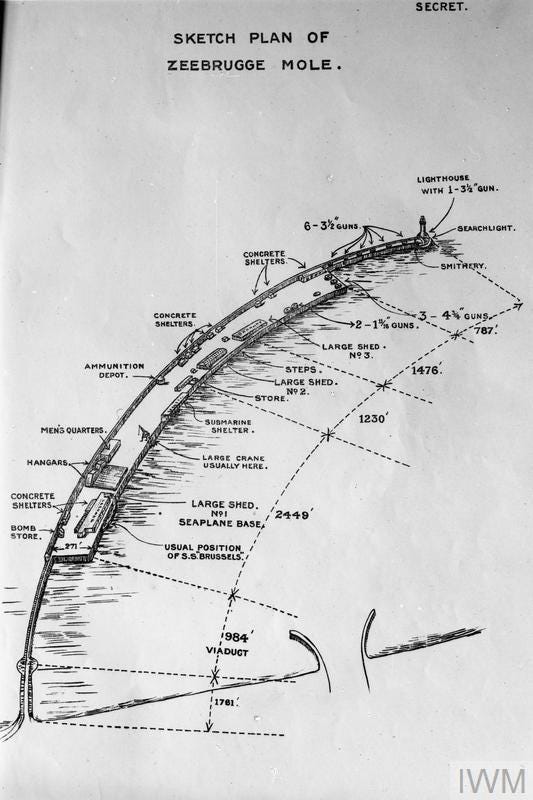
Creatively dubbed Operation ZO, the planning for the Zebrugge and Ostend raids was haphazard. Keyes, although commander of the Dover Patrol area, had no staff fit to plan an operation this complex. Much of the time between conception and execution was consumed with finding obsolete vessels to use as both block ships and a troop transport and then completing the necessary modifications. This was especially true for the HMS Vindictive which would land the troops on the Mole. The height of the Mole was much higher sea level so special gang planks had to be fitted to the Vindictive to allow the troops to cross over.
Zeebrugge is usually depicted as an early example of a commando-style special forces raid, but I don’t find that frame compelling. First, there were no standing organizations that specialized in such operations at the time. Nor were they defined in any military doctrine of the time. This is not to say that what today we call special operations or irregular warfare did not happen, merely that no one in 1918 thought about things in these terms. Secondly, both Navy and Royal Marines participants were drawn from highly conventional organizations, and Keyes approached the problem as such. Neither Royal Marines nor Royal Navy sailors were strangers to amphibious and naval raids; examples like “cutting out operations” were centuries old by this point and a standard mission for “conventional” units. Lastly, the landing force at Zeebrugge alone was composed of fully 1,000 Royal Marines and sailors. That is the equivalent of a large battalion, not a commando group, and that does not even count the naval task force offshore nor the Ostend raid which happened simultaneously. The operation order even had plans to establish a battalion headquarters on the Mole.2 This was a large operation planned in a traditional manner, far larger than what are typically defined as special operations. Later conceptions of Zeebrugge as a special operation are simply wrong.
While the planning phase didn’t go well, the execution phase was even worse. The raids were first attempted on the night of 11/12 April 1918. While in transit, the operation was called off for weather but a British vessel, Coastal Motor Boat (CMB) 33, got lost in the dark. CMB 33 was captured by the Germans complete with the secret order for the Ostend portion of the raid. One German commander later stated that even though the Zeebrugge portion was not captured, it was easy enough to guess that the British would try to block that canal as well.3 The German defenders thus were on high alert when the raid actually occurred on the night of 22 April, ten days later.
Despite the forewarning, the Germans are still surprised by the amphibious part of the raid, but the British run into bad luck right away. The German guns mounted on the Mole were designed to protect the canal, but the gunners spot the HMS Vindictive before they spot the approaching blockships and fire on it instead. The landing force suffers a large number of casualties including all of its senior officers before they even reach the Mole.
The Vindictive still manages to reach the Mole and the surviving Marines and sailors are initially not contested as they run across the gangplanks to the concrete Mole. However, despite the fact that there are few if any German infantry troops on the Mole, the Marinier-Korps artillery gunners are proficient enough with rifles and machine guns to quickly neutralize the small numbers of British that manage to make it off the Vindictive and other ships. Compounding the difficulty is that the troops were under orders to assault the guns with bayonets only to avoid attracting German reinforcements, as if there wasn’t enough noise already. Once the troops are pinned down, the retreat is sounded and the troops that are able to move return to the Vindictive, which launches and returns to sea. Meanwhile, two of the three blockships had arrived at the canal and were scuttled at the entrance.
Since only two of the three block ships reach their intended target, German engineers easily and quickly clear the canal after the battle. At Ostend, no blockships reach their target and the canal is never blocked. The German Admiralty reported ten killed and twenty-five wounded.4 British figures are, even today, different in different sources. Around 227 Marines and sailors died and another 350-400 wounded. About 19 are left behind when the Vindictive launched away from the Mole and were captured.
Despite the lack of anything like success at Zebrugge, the raid is presented to the British public as a grand victory. The survivors are feted as heroes, not undeservedly given the audacity of the raid and the fact that they all volunteered specifically for the mission given the high risks. Roger Keyes would go on to establish the Combined Operations Headquarters which would plan similar raids on Nazi Germany controlled Europe during World War II, including the disastrous Dieppe Raid (although Keyes himself was replaced before that raid occurred).
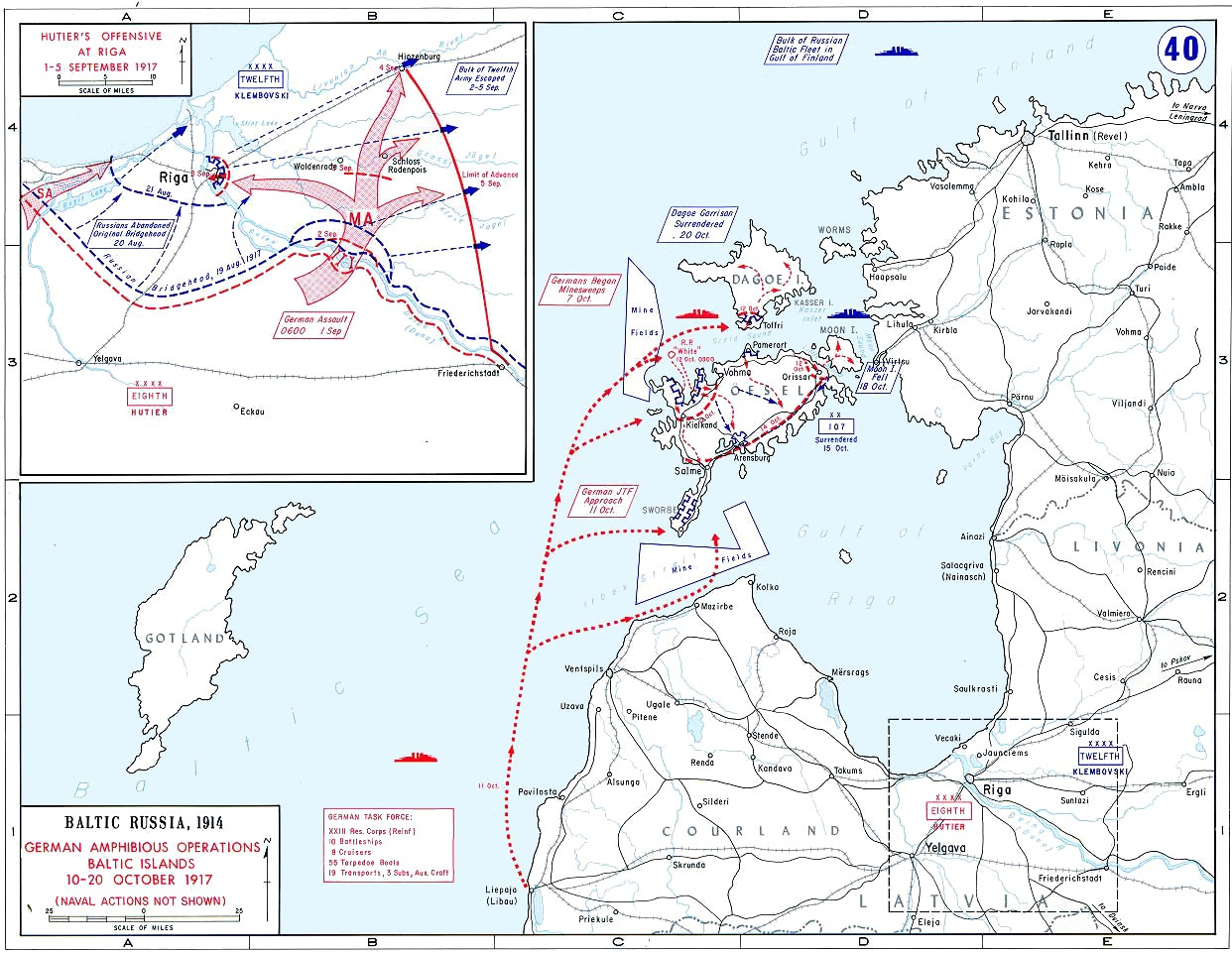
Most people familiar only with Gallipoli point to it as an example of the folly of amphibious operations during this time period, but there is another less well-known example: Operation Albion, the German amphibious invasion of the Russian held islands that guard the opening of the Gulf of Riga off the shore of modern-day Latvia and Estonia.
The best book-length source for this is Operation Albion by Michael B. Barret. However, I only have enough shelving for a portion of my books and my copy is storage so the brief description below is based on Eric Sibul’s chapter on Operation Albion in On Contested Shores Volume 2.
Operation Albion was planned in just a few weeks even though the Germans lack any formed of joint doctrine and is likely the first operation in history with an appointed independent air commander (at Gallipoli, the aircraft fell under the Royal Navy task force). The ultimate purpose is to support the German land offensive to capture Riga. The German left flank was anchored on the sea but was subject to attack by Russian naval forces. To eliminate this threat, the Kaiser ordered the seizure of key islands at the mouth of the Gulf of Riga to bottle the Russian Navy up in the Bay.
The islands are held by about 24,000 Russian troops, roughly equal to the 24,000 troops the Germans commit to the landings. However, Russian naval forces are outmatched, with only two older battleships available along with an assortment of cruisers, destroyers, submarines. The German Navy, by contrast, employs 10 dreadnaughts as part of their force along with 50 faster torpedo boats. The largest advantage is German airpower with five airships and 102 aircraft. The Russians are able to muster no aircraft to defend the islands.
But the Russian defense of the islands includes both heavy coastal guns and minefields, making the operational problem anti-access/area-denial for which the Germans would have to find a counter in amphibious maneuver. In the event, the Russians do a poor job coordinating these defenses unlike the Ottomans at Gallipoli. German naval vessels are unmolested as they clear the minefields protecting Taga Bay on the island of Ösel, where the main German landing took place. Clear of the mines, the German battleships easily knock out the Taga Bay coastal guns.
The Russian plan of defense was to assume a successful German landing but thereafter reinforce the islands from the mainland and then push the invaders back off the island, perhaps a bastardized understanding of the Turkish defense at Gallipoli. But the Russians did not account for the speed at which German troops seized their objectives due to a niche capability: bicycle troops.
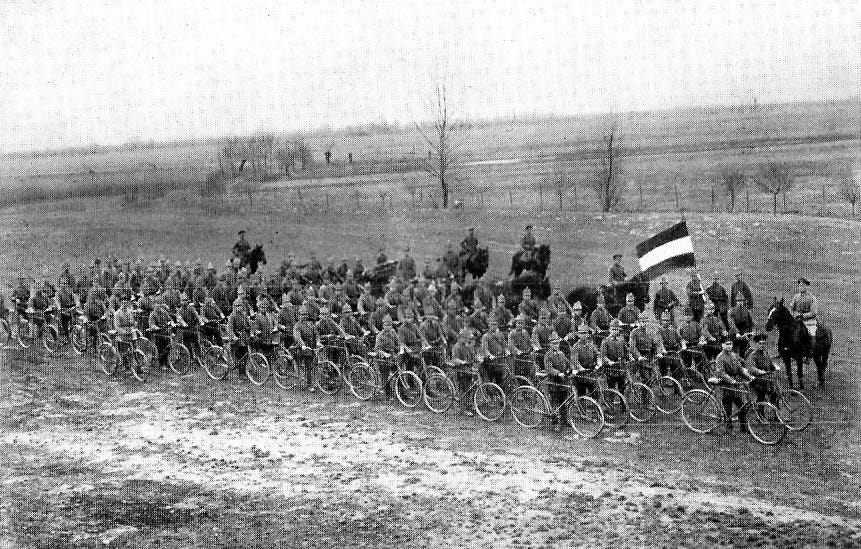
Many different militaries employed bicycle troops during World War I. They essentially operated like dragoon cavalry: using their bicycles for mobility but dismounting to fight. During Operation Albion, the Germans landed multiple bicycle battalions first to seize key terrain and conduct reconnaissance for follow-on forces. The bicycle troops moved so fast they disjointed the Russian defenses and caused enough confusion that Russian forces retreated. They seized their objectives so fast that by the time the Russians marshalled reinforcements, the islands were already in German hands. Casualties were extremely light, and not just by World War I standards. The Germans only lost about 300 total killed between soldiers and sailors, and over 20,000 Russians surrendered in mass. The main objective, the island of Ösel, was the largest and the target of the first German landing. It falls so fast the islands of Moon and Dagö fall with little Russian resistance to speak of.
Operation Albion seems to indicate that amphibious warfare was still possible and the problem at Gallipoli and Zeebrugge are not inherent to the practice, but something wrong with the British specifically. In other words, the Germans might say das ist ein kompetenzproblem.
However, Operation Albion is executed against an Imperial Russian Army and Navy that no one would ever accuse of being competent and was in an advanced state of decay. Indeed, Operation Albion occurs the September before the October Revolution where the Bolsheviks seized power. The Russian Tsar had abdicated seven months before. Massive Russian Army desertions had begun the previous summer. Had the Russians been able to mount a defense as competently as did the Turks, the outcome of Albion might well have been different.
In a great historical irony Gallipoli, which was intended to collapse the government in Constantinople, failed to do so while Operation Albion’s success caused the collapse of government in Saint Petersburg. Yet, it was ultimately the Allies who won the war and not the Central Powers.

In meta news for this publication, this the last post where I’ll cover World War I amphibious warfare. The research is complete for the fifth chapter of my dissertation which will cover Gallipoli as its case study. Now, I have to actually write that chapter and that has already begun.
It’s also become clear that the Gallipoli chapter won’t be long enough to hit the word requirement which necessitates adding another case study. This isn’t a disaster as I have already cut two planned case studies from my original plan so I simply need to resurrect one. This will inevitably be a focus on the Interwar Years which is an even bigger job than the massive Gallipoli chapter. I’ll have to cover not just the British but the Americans and Imperial Japan.
With four chapters down and two to go, one with a massive amount of terrain to cover, I’m at the point in this dissertation where I have to focus on landing the plane I’ve been building in flight for the last three years. It’s crunch time and the faster I write this thing the less tuition I’ll end up paying. I will rarely be posting here if at all until I do bring this thing down. Post dissertation, likely late 2027, I’ll be moving this publication to a different platform, likely Ghost. Substack works for me now because I can use it for free and don’t have to charge readers. Given the dissertation, I can’t commit to writing often enough to make paying for it worthwhile to anyway. Post dissertation, that will change and so will my platform. I’ll maintain this page and post news when that happens.
In the meantime, if you’re interested in supporting my work the best way to do so is always to buy, recommend, or request my books from your local library. I’m lucky that I’m able to do so but I am self-funding my tuition, so the occasional royalty checks I receive are always appreciated.
Signing off for now.
I did not cover the British involvement with the seizure of Qingdao in 1914 in this series because the British contingent was small, only two battalions, and the operation was largely planned and executed by the Imperial Japanese Navy which will be covered later in the dissertation.
Lake, Deborah. The Zeebrugge and Ostend Raids 1918. Pen & Sword 2015. Page 116.
Lake, 90.
Lake, 160.
I would say that describing the Jutland operation as a breakout attempt is misleading. The Germans were trying to engage and destroy part if the British fleet ot their terms. Not breaking out anywhere.
Saying that they never tried another "breakout" is even more misleading. They tried another Jutland style operation in August 1916, and a similar operation in 1918.
"However, I only have enough shelving for a portion of my books and my copy is storage " What is it the kids say? "you are seen". Good post- nice write up and comparison. Your remark about mission accomplishment and it's relation to supporting the strategy as a tell to who won a close battle is well made. Best wishes on a successful dissertation. Cheers.