
This series is composed of quick thoughts as I move through a stack of books as I research a dissertation chapter on the Gallipoli Campaign. They’re not full reviews, just stray thoughts.
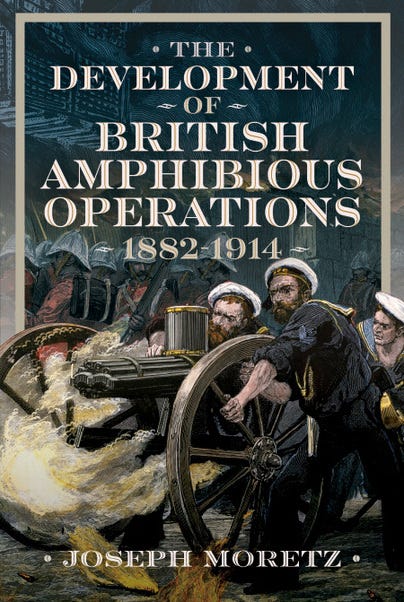
The next book on my stack was a brand new one, The Development of British Amphibious Operations 1882-1914 by Joseph Moretz. This book was a great read as it covers a lot of British operations that I wasn’t familiar with and therefore it had a lot of new-to-me material. These include wars in Egypt, Sudan, Burma, Sudan again, South Africa, China, and Somaliland.
This is critical context for my chapter because the book lays out exactly what the British were focusing on in the decades prior to Gallipoli. And the answer is that they were generally wasting their time with Army interventions in unimportant areas against adversary that posed no real threat to the British Empire.
Where I differ with Moretz is in the definition of amphibious warfare. I define amphibious warfare as any case where troops are to be landed on a hostile shore, one that will or can be defended (whether it actually is defended or not). Expeditionary warfare, by contrast, is where there is a non-hostile shore, port, or airport where troops and equipment can be disembarked administratively without opposition. Amphibious warfare frequently transitions to expeditionary warfare once a beachhead is established and follow-on troops can come ashore through that secured beachhead. A good example is Guadalcanal. The first landings by the 1st Marine Division were amphibious warfare because the island was controlled by the Japanese and they had to presumed the landings would be contested. The Japanese did not, in the event, contest the landings but the planners couldn’t know that. Reinforcing Army units that arrived later were not executing amphibious warfare but expeditionary warfare: they could plan to land on a shore already controlled by Marines.
These two forms of warfare are similar but also the difference between landing on a hostile shore and a friendly shore is massive, and planners must treat the two very differently. That being said, the majority of the operations covered by Moretz in this book are fundamentally expeditionary in nature and not amphibious at all. This doesn’t make it any less valuable, just an important distinction for my dissertation.
Of real value here is the chapter on the Russo-Japanese War. Although the UK was not a combatant, they did have observers present throughout the Imperial Japanese Army and Navy. One of these observers, Sir Ian Hamilton, would go on to command the Mediterranean Expeditionary Force during the Gallipoli Campaign. It was an ideal preview of 20th century amphibious warfare which, of course, would go to waste. Another chapter covers joint exercises during the period which is helpful to understand how the Royal Navy and British Army were trained and educated prior to Gallipoli.
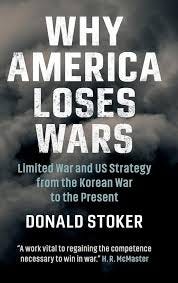
Speaking of wasteful military operations in unimportant regions against middling non-threats, there’s a lot going on right now in US defense not all of which I can actually pay attention to given dueling work and school requirements. If you’re looking for insights into how the US keeps getting itself into these messes, I recommend Why America Loses Wars by Donald Stoker. Bottom line up front: when we locked in the arrangements made for unlimited wars via the National Security Act of 1947, it set the country on a path to be very good at unlimited wars but also very bad at limited wars. Hence why the U.S. can kick the Taliban out of Afghanistan or Saddam out of Baghdad or a matter of weeks, but then it struggles with anything other than such unlimited ends. The current administration is rightfully receiving a lot of criticism from both the “left” and the “right” about how this war has been mishandled from the start, but we shouldn’t lose sight of the larger structural problems at play in U.S. strategy. Stoker lays out one part of those structural problems.
I appreciate your definition of amphibious/expeditionary. I’ve been looking at “landing parties, expeditions, and advanced base work” in an examination of amphibious doctrine before the term was even coined.
I think I got pretty close.
Going to have to introduce myself to General Gray’s writings today…
Thank you for the reviews.
My impression of the 1905 conflict is that just about everybody sent observers who sent back copious notes on the many, many lessons to be learned which were promptly and completely ignored by everyone.