Gallipoli Diaries I
A Year in the Life of a Dissertation

This week Fire for Effect passed 3,000 subscribers. I know this is free and effortless, but I truly appreciate every subscriber. Three thousand is a lot for someone who doesn’t write often and on a platform that frankly has a lot of problems. None of the other free platforms work for me though and the paid ones are too expensive for someone paying tuition for himself and soon will have another kid in college too. So thank you.
Unfortunately, my writing pace won’t be increasing this year. This series will most likely be the only thing I write here over the next year. The next chapter I’m researching and writing for my dissertation is the Gallipoli Campaign, and there are far more sources to wade through than previous chapters. It’s also much larger in scale as a case study so I’ve budgeted the entire year to do it. There won’t be a lot of analysis in this series; that’s what the chapter is for. It will mostly be random thoughts and observations as I chew through a stack of book and sources.
The Gallipoli Campaign is the crux of my dissertation. My main argument is that British military forces followed a consistent, tested, well-developed approach to amphibious warfare from the late 16th century through World War II, an approach I'm calling the Anglo-American amphibious warfare doctrine because it was passed to the Americans through the colonial experience. But the Gallipoli Campaign sits like a big scholarly red flag right in the middle of this time period: if the British approach to amphibious warfare was so refined, why did it fail?
So I either have to argue that the British faithfully executed their usual doctrine and it failed (and why) or they did not follow their usual doctrine at which point I have to explain both why they didn’t and what that means for the overall thesis. The latter makes things more difficult for me.
I’m early in the research on this chapter but so far everything is indicating that they just didn’t do their usual doctrine. Like at all. Why that is I’ll have to figure out. Was Ian Hamilton just a dolt of a general? Did Kitchener get too in the weeds from far off London?
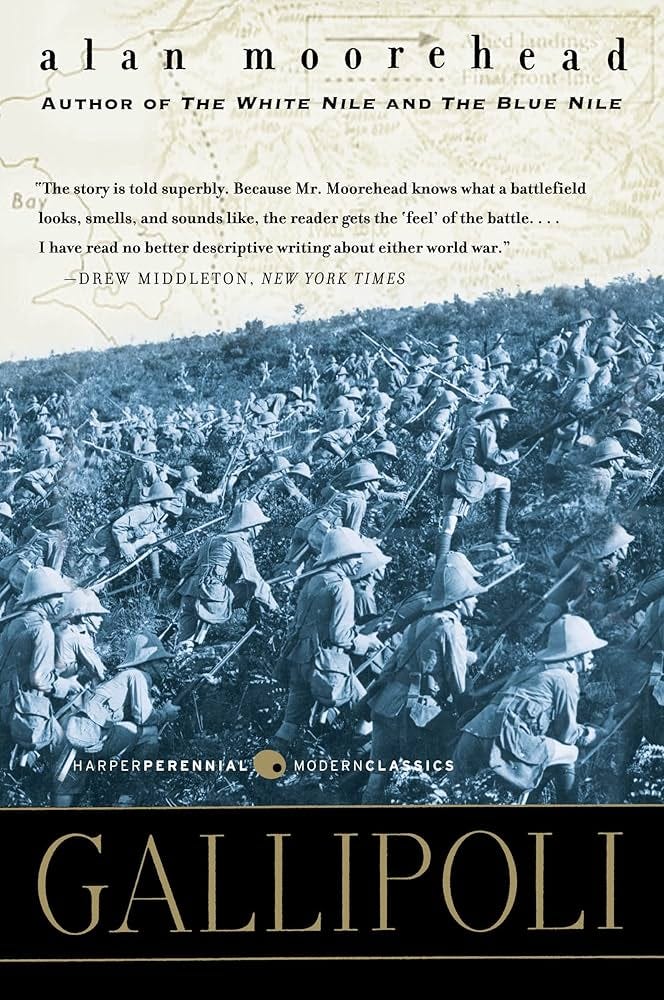
The first book on the stack is Gallipoli by the journalist Alan Moorehead. It’s actually a reread for me, but enough time has passed that I need the refresh. Written in 1956, Moorehead approaches the campaign as a storyteller rather than a historian or an analyst which makes it a perfect introduction. Moorehead excels in character studies, so if you’re not familiar with the younger Winston Churchill, Jackie Fisher, Horatio Kitchener, Ian Hamilton, Mustafa Kemal (the future Kemal Ataturk), or the rest of the cast of characters, it’s a great place to start. Moorehead doesn’t neglect the naval aspects of the campaign either and the submarine operations are particularly good reading.
Moorehead does his best to cover the campaign from both sides, especially focusing on Mustafa Kemal and Liman von Sanders, the German commander of the Turkish troops, but this book is still solidly written from the British perspective. The French perspective gets lost in his focus on the Commonwealth soldiers, the British high command, and of course the Turkish defenders.
The perennial question of the Gallipoli Campaign is who is responsible for the British failure? Moorehead places the blame squarely on the British high command and mostly on Winston Churchill himself as the most enthusiastic proponent. While Churchill is certainly the most enthusiastic proponent, the need to open a route to Russia was not his idea (it was the desire of Asquith, the Prime Minister, responding to a request for help from Czar Nicholas II), nor did he have any involvement in the planning for the military side of the campaign, which was dominated by Kitchener. Kitchener’s instructions to the Army commander, Ian Hamilton, are short and simple.
What’s striking about them is the presumption that the troops would get ashore. There is no thought whatsoever that they would not be able to get ashore and then transition to a more conventional expeditionary campaign among any of the high command leaders. And from their perspective, why would this be in doubt? The last time I can find that British troops failed to get ashore and reach their objective prior to Gallipoli is the Battle of New Orleans, exactly 100 years prior. No one alive in 1915 had ever seen a British amphibious operation fail. Why would they think this one would?
But that’s also a weakness. The British were so good at amphibious warfare for so long that either 1) no one had thought to test their doctrine for how to execute an amphibious operation or 2) no one remembered the doctrine given that this was a time before formalized, written doctrinal manuals. Did Hamilton execute the Gallipoli landings in accordance with long-standing British doctrine (informal as it was) or did he not? If he did not, would it have succeeded if he had?
Those are the questions for this series, and we’ll eventually link those questions with the major amphibious warfare theorists of the day, Julian Corbett and Charles Callwell.
Sounds like an excellent dissertation topic! Out of interest, have you come across Aimee Fox, Edward Erickson or Mesut Uyar yet in the academic literature? Have recently done some academic work myself on the Great War in the Middle East and found them extremely useful.
Strongly suggest reading these two gems by Moretz:
"The Development of British Amphibious Operations 1882-1914"
"British Amphibious Operations of the First World War".
They may have some answers to that question of why they abandoned established doctrine...